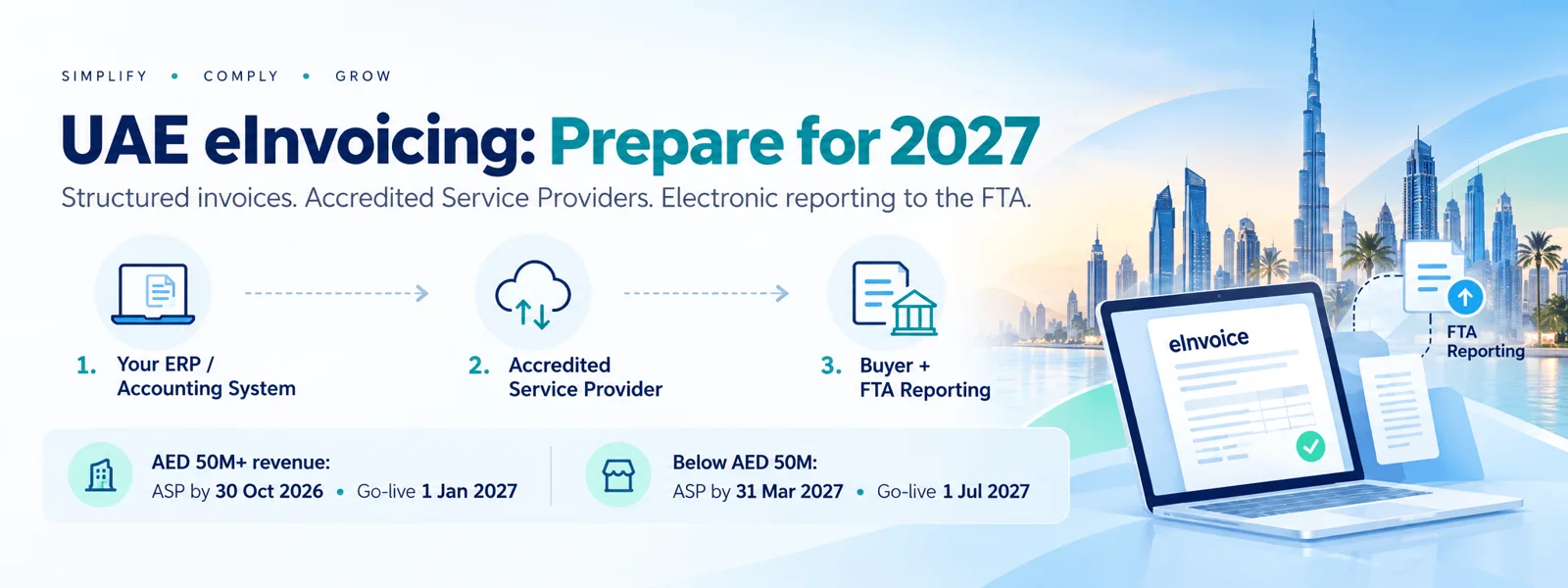
The UAE’s eInvoicing framework will require businesses to exchange structured electronic invoices through a UAE Accredited Service Provider (ASP). A PDF sent by email is not considered an eInvoice under the new framework. The system is based on OpenPeppol, with invoice data exchanged in the UAE’s structured eInvoice format.
Key UAE eInvoicing deadlines
Annual revenue ≥ AED 50 million
Appoint an Accredited Service Provider by 30 October 2026
Mandatory eInvoicing implementation from 1 January 2027
The ASP deadline was officially extended from 31 July to 30 October 2026.
Annual revenue < AED 50 million
Appoint an Accredited Service Provider by 31 March 2027
Mandatory implementation from 1 July 2027
Government entities
Appoint an ASP by 31 March 2027
Mandatory implementation from 1 October 2027
Getting ready is more than simply changing your invoice layout. Businesses should review their ERP master data, VAT/TRN information, invoice and credit-note processes, required data fields, integration capabilities, validation workflows, error handling and connectivity with their chosen ASP.
Whether you are running Microsoft Dynamics 365 Business Central, Odoo, or a custom ERP, preparing the integration early can make the transition considerably smoother.
At LuminareSoft, we help businesses assess their ERP landscape, identify eInvoicing readiness gaps and build the integrations and automation required for the UAE’s evolving digital compliance ecosystem.